By: Mona Lyn D. Almarines
Staff Member
The family is the smallest unit of the society, yet it remains to be the most influential. In the Philippines, each and every member of the family is being shaped from childhood to adulthood by infesting every core value being implemented by our elders form the smallest foundation of the society.
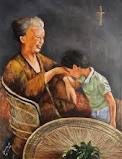
One of the sweetest learning my parents have taught me in my childhood days in the “Mano Po”. I remember that whenever we meet an elder, we would gracefully and slightly bow our head, then take the elder’s hand courteously and places it on our forehead, followed by politely saying “Mano Po”. In return the elder would say “Esta de buena Santa”, or “Dios le bendice”. (The place where I came from was once inhabited by Spaniards. This is the reason why the elders were likely to speak Spanish or Latin during that time.)
Mano is a Spanish term which literally means hand the proceeding PO is a common Filipino jargon denoting a notion of respect. When combined, it creates a charning sign of showing respect to the elders which plainly means, “Your hand, please”. It is actually done when one visits a family, meets elder people outside of the homes or after a religious activity such as Mass or Prayers. While in certain parts of Asia, it is respectful to bow to another person as sign of respect to them, the Philippines is the only country in Asia that has this unique custom and tradition which originated from Spanish era during their occupancy as sign of respect for the clergies. The other way of “Pagmamano” is where kisses the hand of the elder or the respected one which is a sign of love, and it’s typically Spanish. As a result, the Filipinos adopted this gesture as means of showing respect to the elders. Sometimes, we exhibit the “Mano Po” upon leaving the house as sign of bidding good-bye to our elders.
However, as we approach the modern variations of cultural traditions, this traditional Filipino value is slowly disappearing. For instance, the “Mano Po” is slowly being replaced by “beso”, a Western custom where the cheeks of a person will come in contact with the cheeks of another person.
I cannot help myself, but ask, why? What’s happening to our very own “Mano Po”? Looking back, there was a time when one of my inaanaks (godchild) approached me to gesture her “Pagmamano.” To my surprise, the mother uttered, “huwag ka nang mag-mano kay Ninang mo. Tatanda agad siya. MagBeso ka na lang” )Don’t do that anymore, your godmother will get old earlier kiss her instead.) I really felt sad about this. Not wanting to be an elderly, why would we refuse this amazing Filipino gesture? there’s no such thing as magic that would make us old if a child gesture the “Mano Po”
Learning from the beauty of the Filipino values and traditions my parents, my elder relatives and my teachers have taught me, I think maybe we should not stop the younger generation from performing this sign of respect. We should moreover contribute to the propaganda of this rich and valuable practice. Imagine when the time comes when we’re already old, and our children and grandchildren are no longer practicing this kind of respect, how would we feel? Soon enough, we will be parents and grandparents too. if we continue on discouraging the younger ones from practicing “Mano po” or “Pagmamano”, by the time we become parents and grandparents, this tradition may have already been forgotten. “
“Mano Po” is in danger of being stale, forgotten or even extinct. i remember during my childhood years, my parents would give me a pinch whenever I forgot to pay my respect to the elders when we visits them by doing a “Mano Po”. They would think I am being disrespectful. That one, that simple act, says a lot about me – how I am raised and how I am raising myself, and how I will also raise my children and the children of my children in the future.
i believe “Mano Po” is a gesture which should be kept in a time capsule because it is a very important practice for all Filipinos, especially with the younger ones. Just a “Mano Po” talks a lot about being a Filipino And since we are in a disapora, the more we should keep our culture and language intact as our legacy to the next generation.
– It makes me feel good that in some ways I am helping my fellowmen to upholds this enthralling tradition. –

Recent Comments